The origin of the second sense is from the practice of some Chinese restaurants which — for a fixed price — instruct the customer to make selections such as “one from Column A, two from Column B, one from Column C”, where the columns may contain, for example, a selection of soups, appetizers, and entrees.
Category: Everyday
everyday life
The word is derived from a Greek word “toxikón”, which is a the arrow of type of bow.
It is thought that this word became our western world meaning of “poisonous” because of the story of Hercules.
Hercules’ second labor was to kill the nine-headed Hydra.
Once Hercules slayed the Hydra, he dipped his arrows in the Hydra’s blood. This made his arrows poisonous.
The ‘spades’ in this phrase refers to the highest suit in cards, not the shovel. How did this shape get its name?
Playing Cards originated in Asia and spread across Europe around the 14th century. It arrived in England a little later than in Spain, Italy and Germany.
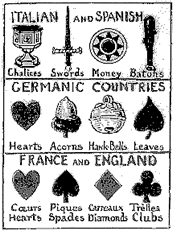 “Essentially, the Italian versions of early cards used the suits Cups, Swords, Coins and Batons — which, on migration to England, became Hearts, Spades, Diamonds and Clubs. The image for Spades on English and French cards looks somewhat like that of the German Acorn or Leaf suits, but its origin is revealed by its name rather than its shape. The Spanish and Italian for sword is ‘espada’ and ‘spada’ respectively, hence the suit ‘Swords’ became anglicized as ‘Spades’.”
So where does the non-card-playing meaning come from? It is an Americanism:
First of all, the phrase isn’t found before the 1920s. Damon Runyon, an American journalist and writer, used the expression that way in a piece for Hearst’s International magazine, in October 1929:
“I always hear the same thing about every bum on Broadway, male and female, including some I know are bums, in spades, right from taw.“
Some other spade phrases: “cocky as the King of Spades”, “call a spade a spade”, “spade something up”
The link between buckets and death was made by at least 1785, when the phrase was defined in Grose’s Dictionary of the Vulgar Tongue:
“To kick the bucket, to die.”
Although there is not much evidence to support it, one theory as to why the phrase originates from the notion: people hanged themselves by standing on a bucket with a noose around their neck and then kicking the bucket away.
Skullduggery (spelled with either a “k” or “c” and/or two “l”s) comes from the Scottish word for adultry: “sculdudrie”. The word is used in modern parlance as a term for underhanded dealings or trickery, often political in nature. Ex. The skullduggery that was Watergate.
The word Skullduggery has been used to title various things from a 1970s Burt Reynolds film to the University of Adelaide orientation week, established in 1896.